mybian.cn

Publications

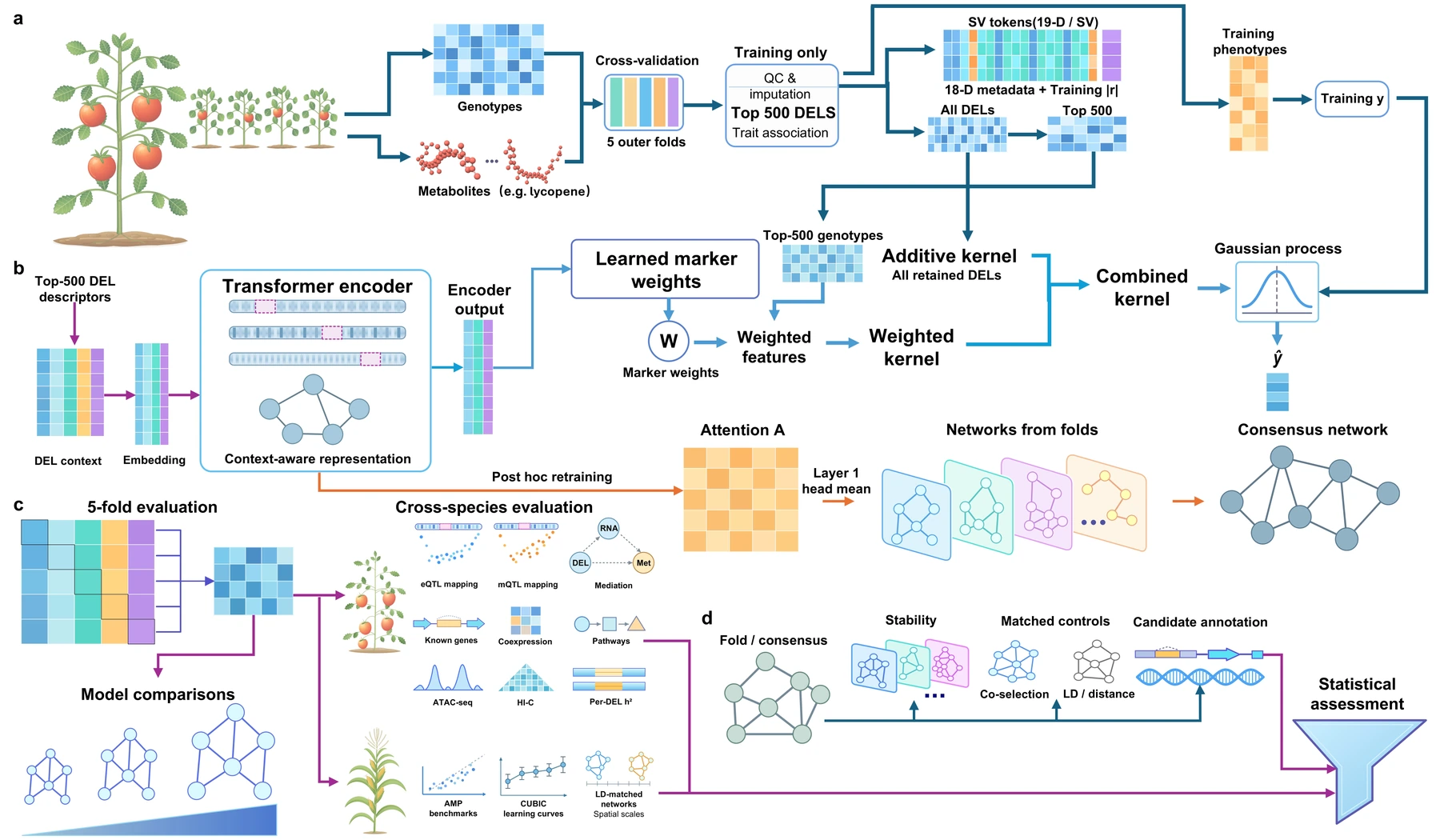
SVDKL framework for metabolite prediction and network evaluation
Horticulture ResearchJCR Q1IF 9.5 (2025)Under review

SVDKL: A dual-channel deep kernel framework unites structural-variation dosage and cis-regulatory topology for genomic prediction and network inference

Mingyu Bian, Yiquan Wang, Shuming Dong, Liqiong Xie, Dongliang Guo, Kai Wei

Co-first author

Variation in tomato fruit metabolites reflects contributions from many genomic variants. SVDKL learns how to weight individual DNA deletions against a genome-wide genetic background and uses cis-regulatory information to prioritize candidate regulatory regions. For 14 low-heritability metabolite traits, the mean Pearson correlation between predicted and observed values rose from 0.125 to 0.156 in five-fold cross-validation against genomic best linear unbiased prediction using the same deletion data.
TRIDENT Figure 1. Three-stage research framework
Horticulture ResearchJCR Q1IF 9.5 (2025)Under review

TRIDENT: a three-stage cascade for orthogonal feature deconfounding and dynamic ligand discovery

Mingyu Bian, Yiquan Wang, Kai Wei

Sole first author

Baseline gene expression differs between wild and cultivated tomatoes and can obscure their responses to drought. TRIDENT combines a cross-species single-cell atlas with root and leaf transcriptomes to separate baseline differences from drought response signals, then uses molecular simulations to evaluate how natural products might bind candidate targets. The computational results prioritize targets and ligands for experimental testing.

arXiv preprint

How much does the geometry of neighboring bends tell us about local protein backbone torsion? We derive a torsion-angle distribution from discrete backbone elasticity and use two elastic states to represent different bending and twisting preferences. Across 1,744 held-out ATLAS chains, the two-state model reduced the mean absolute error in geometric helix fraction from 10.41 to 1.65 percentage points relative to the single-state model.

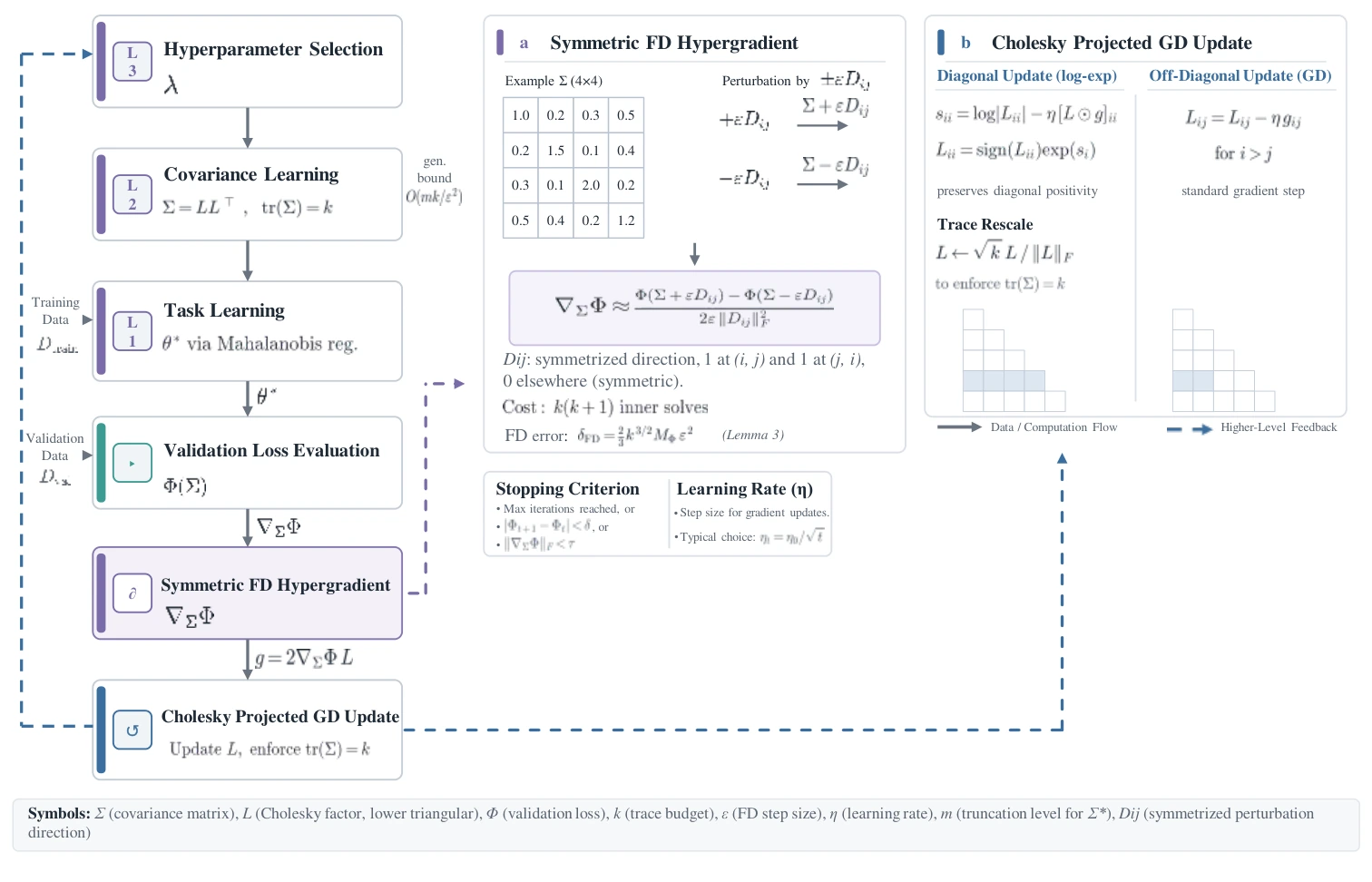
Structured bilevel covariance-learning workflow
AAAI 2027SubmittedCCF A

Structured Bilevel Covariance Learning for Shared-Design Multi-Output Regression: Convergence, Complexity, and Empirical Analysis

Co-first author

When regression outcomes share the same inputs, their dependencies can inform prediction. We fit regression coefficients in an inner optimization, learn cross-output covariance from validation loss in an outer optimization, and derive convergence and generalization bounds. On two airfare prediction benchmarks with six outcomes each, test mean squared error fell by 9.4% and 9.0% relative to independent ridge regression with a fixed penalty. Alternating covariance learning and independently tuned ridge regression reached lower errors in the same evaluation.

CITSC 2026AcceptedEI conference

CoDA-Pipe: An Integrated Computational Pipeline for Classification and Interpretation of Compositional Data

Wenzhe Chen, Mingyu Bian, Guanzhe Wang

Co-first author

Weathering changes the chemical composition of ancient glass, and measured component proportions add up to a fixed total. CoDA-Pipe represents relative composition using centered log-ratios, estimates pre-weathering composition through weighted similarity matching, and classifies glass using principal component analysis and K-means in a hierarchical procedure. On eight samples of unknown type, assignments remained stable under simulated measurement noise, and changing the classifier altered subtype assignments for three samples.

AAAI 2027SubmittedCCF A

Marginal Fidelity Is Not Enough: A Controlled Study of Synthetic-to-Real Failure in cfDNA Screening

Co-first author

Synthetic data can reproduce individual feature distributions while losing the joint predictive signal needed for cell-free DNA screening. We compare six generators by training classifiers on synthetic data and testing them on a real cohort. XGBoost achieved an AUC of 0.783 with real training data. The six estimates with synthetic training data ranged from 0.484 to 0.518, close to the chance value of 0.5.

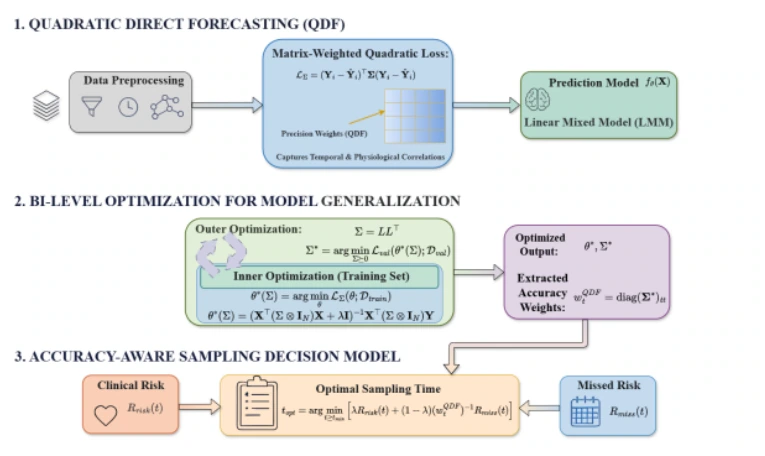
QDF-NIPT overall model and decision framework
ICIC · SpringerCCF C

QDF-NIPT: A Bi-Level Optimization Framework for Precision Prediction and Decision-Making in Prenatal Fetal Concentration Analysis

Wenzhe Chen, Mingyu Bian, Xinyu Shu

Co-first author

ICIC 2026 conference paper. First published online in 2026. The proceedings citation is dated 2027, LNBI volume 16668, pp. 268–280.

QDF-NIPT uses bi-level optimization to predict fetal fraction and choose a sampling time for non-invasive prenatal testing. It learns how prediction errors are related across gestational weeks and balances risk against predictive precision when choosing a time. In simulations, prediction root mean squared error fell from 0.521 to 0.442 relative to a standard linear mixed model. With predictions held fixed, its sampling policy also had lower decision regret than a fixed-window rule.

ABCM 2026AcceptedEI conference

An Integrated Computational Framework for Optimal Timing Decision in Multi-Source Monitoring Scenarios

Wenzhe Chen, Mingyu Bian, Guanzhe Wang

Co-first author

The choice of testing time in multi-source monitoring depends on longitudinal trends, individual variation, and measurement error. The framework models changing indicators with mixed effects, estimates event timing from interval-censored observations, and ranks candidate times across criteria. In Monte Carlo perturbations of a prenatal screening case study, testing times selected by the multifactor model shifted by about 0.2 to 0.5 weeks across four BMI groups.